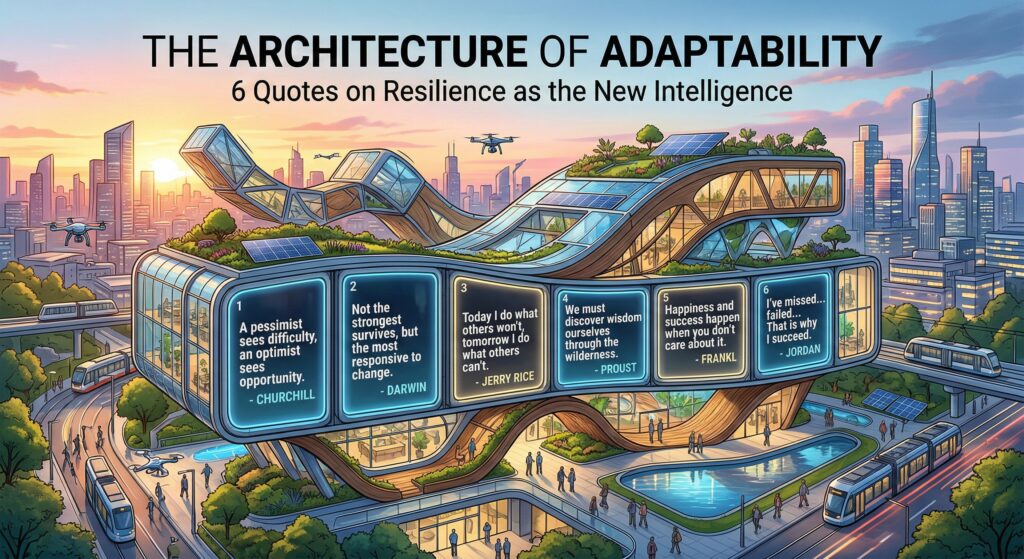
The Architecture of Adaptability: 6 Quotes on Resilience as the New Intelligence

I have collected hundreds of quotes over the years for inspiration. I wanted to share a few of these and my comments on how these quotes help me shape my business and design my lifestyle.
“We are not provided with wisdom; we must discover it ourselves, after a journey through the wilderness which no one else can take for us.”
Marcel Proust

We can read all the books, listen to every single podcast, watch every single documentary or YouTube video: This doesn’t change us. We only learn by doing – and failing. We have to practice and tumble to absorb the wisdom of all that content. How many times have I tried something and failed, only to remember a piece of wisdom from a book that had warned me about that mistake? “Now I get it – that’s what they meant in that book“. We only learn from our own journey – and mistakes.

“It is not the strongest of the species that survives, nor the most intelligent, but the one most responsive to change”
Charles Darwin

This is more true than ever. With the advent of AI, things change all the time. I’ve seen so many companies die in recent years because they failed to adapt and change their business model. Sears didn’t respond to Amazon, and they are gone, like many others. My business has gone through at least 4 major pivots in the last twelve years, and I’ll need to pivot again soon if I want to keep going.

“I’ve missed more than 9,000 shots in my career. I’ve lost almost 300 games. 26 times, I’ve been trusted to take the game-winning shot and missed. I’ve failed over and over and over again in my life. And that is why I succeed.”
Michael Jordan

This classic quote from Jordan says it all. Success isn’t linear. It’s all about trying, over and over again, no matter the outcome: persistence, resilience, and not giving up when things go wrong. The process is humbling, and what makes the difference is resilience.

“Happiness must happen, and the same holds for success: you have to let it happen by not caring about it.”
Viktor E. Frankl

This is one of my favorite tricks for carrying on no matter the outcome. If I write a piece of content, I forget about it as soon as I hit publish. I don’t care whether 5 or 5,000 people end up reading it. I don’t worry about statistics. I don’t care much about likes, followers, reshares, and such. I keep going, do the work, and focus on quality. I wasn’t always like this, but I realized that when I cared too much about numbers, I was more inclined to give up or change my approach before giving it any chance to succeed.

I’m still surprised when people recognize me at conferences and come up to thank me for what I do, because I never expected it, and that’s why it happened and keeps happening. Frankl’s quote actually goes on like so: “I want you to listen to what your conscience commands you to do and go on to carry it out to the best of your knowledge. Then you will live to see that in the long-run – in the long-run, I say! – Success will follow you precisely because you had forgotten to think about it.”

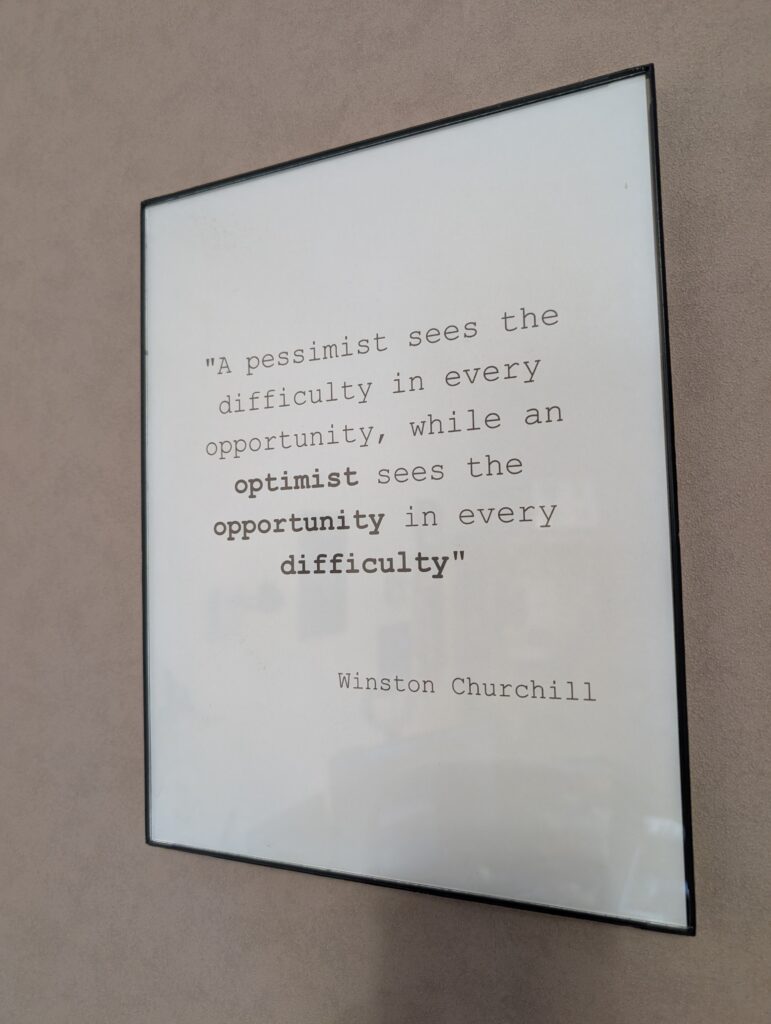
“A pessimist sees the difficulty in every opportunity, while an optimist sees the opportunity in every difficulty”
Winston Churchill

That one is actually hanging in my office right next to me, so I get reminded about it every day – it’s a little bit like seeing the glass half-full rather than half-empty:
Is AI going to destroy my current business offering? Most likely yes, so I need to embrace it and use that as an opportunity to pivot and offer something different. Change is an opportunity to learn and grow. This quote ties so nicely with the previous ones: Adapt to survive, make mistakes to learn, and then succeed. As Ryan Holiday puts it, the Obstacle is the way.

“Today I will do what others won’t, so tomorrow I can do what others can’t.”
Jerry Rice

Kevin Costner has a variation of that quote: “Being an entrepreneur is being willing to do a job that nobody else wants to do, in order to be able to live the rest of your life doing whatever you want to do“. The idea is the same. Nobody wants to feel the pain of failure, so most people won’t even try. Yet we must try, as this is how we pave our way to success.
How to speak at conferences?

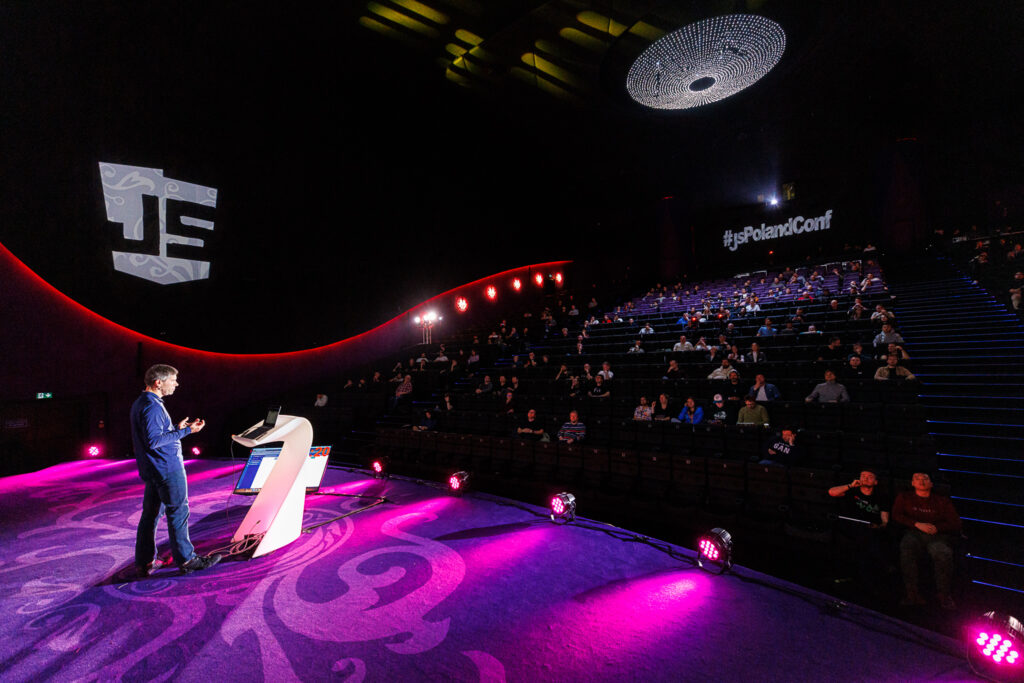
If you’ve ever wondered how people end up on stage speaking at conferences, this article is for you. I’m going to describe the different steps and share some tips & tricks to increase your odds of success. These are lessons I learned over the past 10 years of successfully giving 50+ talks on all continents.

  1. Finding the right conference

The first thing to know about conferences is that they are planned months in advance, and speakers are typically selected at least a few months before the event. As a result, your first step when looking for a conference to speak at is to determine when it will take place. If it’s next month, it’s most likely too late to apply to speak. Most conferences select their speakers four months to a year before the event!

To find such events, you can use AI, Google search, or aggregators such as Papercall, Sessionize (you need to create a speaker account first – it’s free), and developer.events.

Once you find an event, the next important thing is the CFP process.

  1. Find the CFP (Call for Papers) dates

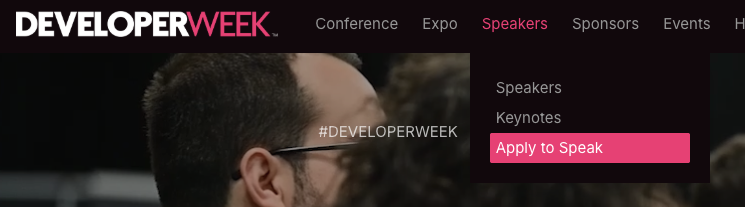
The call for papers (CFP – sometimes Request for Papers – RFP) process is how anyone can apply to speak at a conference. This information is always available on the conference website at some point, usually under a “Speakers” or “CFP” menu:

If you can’t find it, it means you’re too early or too late. The next thing to know about CFPs is that they have a start date and a closing date, which sometimes leave only a short window of time (a month or two) to apply. This is why knowing the dates is crucial: I’ve missed so many conferences when I started public speaking because I missed the CFP dates… Most of the time, you’ll find something like this on the conference website:

I check CFP dates for events I want to speak at once a month. Another option is to contact the organizers, as contact info is always available on conference websites, but don’t expect an answer: they receive tons of messages and tend not to check their email inboxes before a CFP starts.

Another key piece of information in the CFP is whether the conference covers your travel and hotel expenses for the event. Most conferences do, others don’t, so make sure you have that information before applying.

3. Apply to speak

Once the CFP for the event is open, you can apply to speak! Most conferences allow you to submit several ideas, but their submission process often requires repeating the same information for each submission (your name, bio, location, etc.), which is painful.

As a result, I have a document where I keep everything conferences typically ask for, so I can copy and paste that info and save lots of time:

Note that websites like Sessionize allow you to store all that info, as well as your talk ideas, so you can reuse it and apply it to other events quickly.

Here are some suggestions for successful conference applications:

  • Make sure you submit talks that are in line with what the conference already does, but not exactly the same topics as in previous events
  • Submit 3 to 5 different talk ideas, not just one (90% of applicants submit just one talk)
  • You will get rejected over and over again. In my first few years as a speaker, I learned I was selected to speak at about 60% of events, so if I wanted to speak at six conferences per year, I’d apply to 10 events.
  • If you’re a new speaker, don’t compete with star speakers who speak at the event every year. Pick a talk duration or format that is uncommon and unlikely to be selected by the “famous” speakers. For instance, if the main talk is 30 minutes but the conference allows 5-minute lightning talks, choose the lightning talks for your first applications. You’ll have less competition!

4. Wait for the result

Once you’ve submitted your talks, wait for the selection committee to make their choice. Again, expect to be rejected quite a bit; that’s perfectly fine, and even veterans like me get rejected several times per year.

5. Prep your content

This is the “easiest” part, in that it’s fully under our control at that point: we can create our content and get ready to deliver it on stage!

If you have any questions or if I missed anything, please let me know, and I’ll update this tutorial with more information.

How to become a Google Developer Expert (GDE)?

The number 1 question I get from people I meet is: How did you become a Google Developer Expert?

I’m always happy to answer that question because I help people learn, develop, grow, and take the next step in their careers every day.

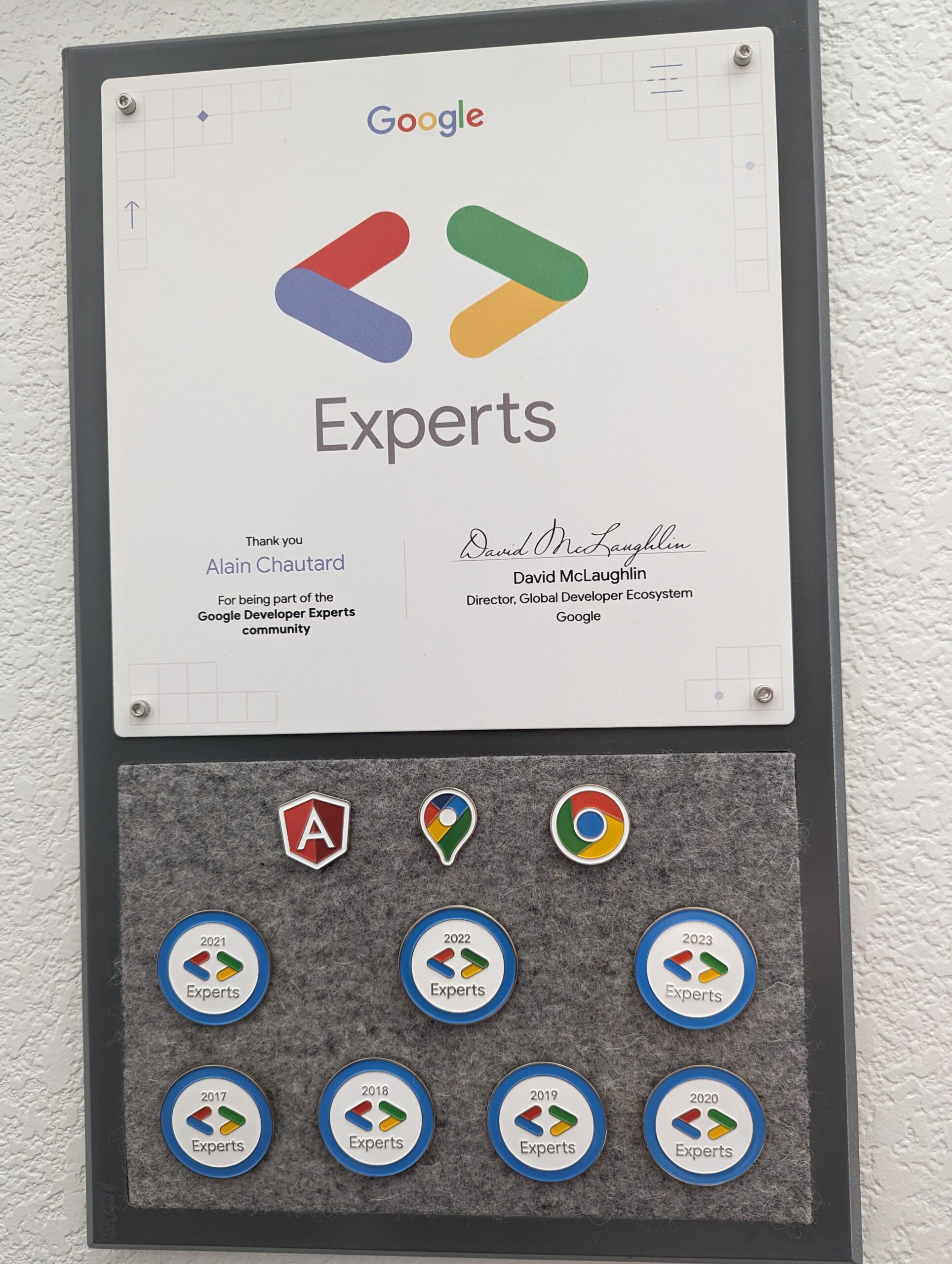
I’ve been a GDE since 2017, so my honorary Experts plaque is starting to run out of space:

If you want a concise answer, here is one for you: If you want to become a GDE, you have to do what a GDE does. That’s it!

If you want a longer answer in podcast format, you can listen to this 80-minute-long podcast episode recorded for Adventures in Angular.

And if you want a more elaborate written answer, stay here and keep reading.

What’s the GDE program?

First, it’s important to understand the Google Developer Expert program and what it isn’t. The program recognizes your expertise and contributions in a Google-centric technology area such as Android, Cloud, Angular, or the Google Maps platform. In other words, it’s a title that rewards everything you’ve done publicly for such a technology and its users.

Being a GDE isn’t about:

  • Becoming a Google employee. Google employees cannot be GDEs; a GDE who becomes a Googler loses their GDE title.
  • Being the best possible coder in that technical area. It’s more about sharing your knowledge, helping others, and providing advice and guidance.
  • Receiving a lifelong award. The GDE title is re-evaluated every year, and if a GDE stops sharing their expertise, they will lose their GDE status.

What Google is looking for in a GDE

The Google Developer Experts page clearly states who can become a GDE (bolding is mine):

Google Developer Experts have a variety of diverse backgrounds. They are developers, founders, mothers, activists, and so much more. The one thing they have in common is that they’re passionate professionals with expertise in Google technology who enjoy continuous learning, sharing knowledge, and making an impact on the community.

Eligibility criteria:

  • Solid expertise in an area featuring Google technology such as Android, Google Cloud, Machine Learning, Web and more. You do not need a formal education to be considered for the GDE program.
  • Display significant contributions in the developer community including but not limited to speaking at events, publishing content, mentoring other developers and companies.
  • Ability to articulate clearly and provide meaningful advice to others.
  • Must be 18+ years old.
  • Ability to interview and communicate in English as it’s the official language of the program.

A GDE is someone who does public speaking (conferences, meetups), creates content (podcasts, videos, blogs, open source projects, books, video courses), and helps others (mentoring, training, tutoring). You don’t have to do all of that, and some GDEs do a lot of one of these and very little of the rest.

When I became a GDE in 2017, I had done 0 conference talks and only a little blogging, but I had done a lot of training and meetup talks (probably 30+ over the past few years). So don’t worry if you’ve never spoken at a conference or are afraid of public speaking. You can produce other types of content that are just as valuable if not more.

What’s really nice about the above eligibility criteria is that Google follows them by the book. If you do all that work, you’ll eventually become a GDE.

With all that in mind, you can see why my TLDR introduction sentence was: If you want to become a GDE, you must do what a GDE does. And yes, it takes time to create content, prepare talks, and build your expertise, which is what makes the GDE title rare and valuable.