The Architecture of Adaptability: 6 Quotes on Resilience as the New Intelligence

I have collected hundreds of quotes over the years for inspiration. I wanted to share a few of these and my comments on how these quotes help me shape my business and design my lifestyle.
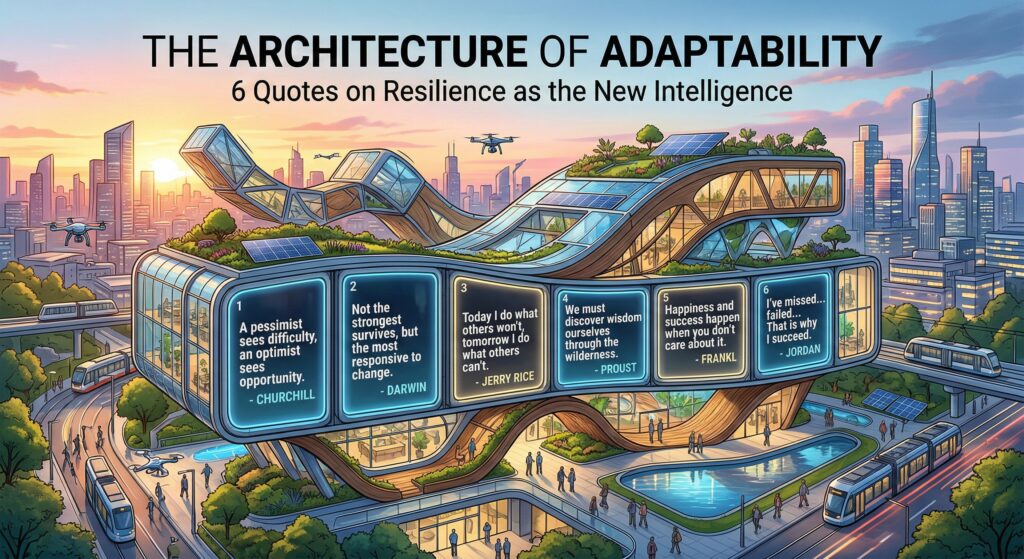
“We are not provided with wisdom; we must discover it ourselves, after a journey through the wilderness which no one else can take for us.”
Marcel Proust

We can read all the books, listen to every single podcast, watch every single documentary or YouTube video: This doesn’t change us. We only learn by doing – and failing. We have to practice and tumble to absorb the wisdom of all that content. How many times have I tried something and failed, only to remember a piece of wisdom from a book that had warned me about that mistake? “Now I get it – that’s what they meant in that book“. We only learn from our own journey – and mistakes.

“It is not the strongest of the species that survives, nor the most intelligent, but the one most responsive to change”
Charles Darwin

This is more true than ever. With the advent of AI, things change all the time. I’ve seen so many companies die in recent years because they failed to adapt and change their business model. Sears didn’t respond to Amazon, and they are gone, like many others. My business has gone through at least 4 major pivots in the last twelve years, and I’ll need to pivot again soon if I want to keep going.

“I’ve missed more than 9,000 shots in my career. I’ve lost almost 300 games. 26 times, I’ve been trusted to take the game-winning shot and missed. I’ve failed over and over and over again in my life. And that is why I succeed.”
Michael Jordan

This classic quote from Jordan says it all. Success isn’t linear. It’s all about trying, over and over again, no matter the outcome: persistence, resilience, and not giving up when things go wrong. The process is humbling, and what makes the difference is resilience.

“Happiness must happen, and the same holds for success: you have to let it happen by not caring about it.”
Viktor E. Frankl

This is one of my favorite tricks for carrying on no matter the outcome. If I write a piece of content, I forget about it as soon as I hit publish. I don’t care whether 5 or 5,000 people end up reading it. I don’t worry about statistics. I don’t care much about likes, followers, reshares, and such. I keep going, do the work, and focus on quality. I wasn’t always like this, but I realized that when I cared too much about numbers, I was more inclined to give up or change my approach before giving it any chance to succeed.

I’m still surprised when people recognize me at conferences and come up to thank me for what I do, because I never expected it, and that’s why it happened and keeps happening. Frankl’s quote actually goes on like so: “I want you to listen to what your conscience commands you to do and go on to carry it out to the best of your knowledge. Then you will live to see that in the long-run – in the long-run, I say! – Success will follow you precisely because you had forgotten to think about it.”

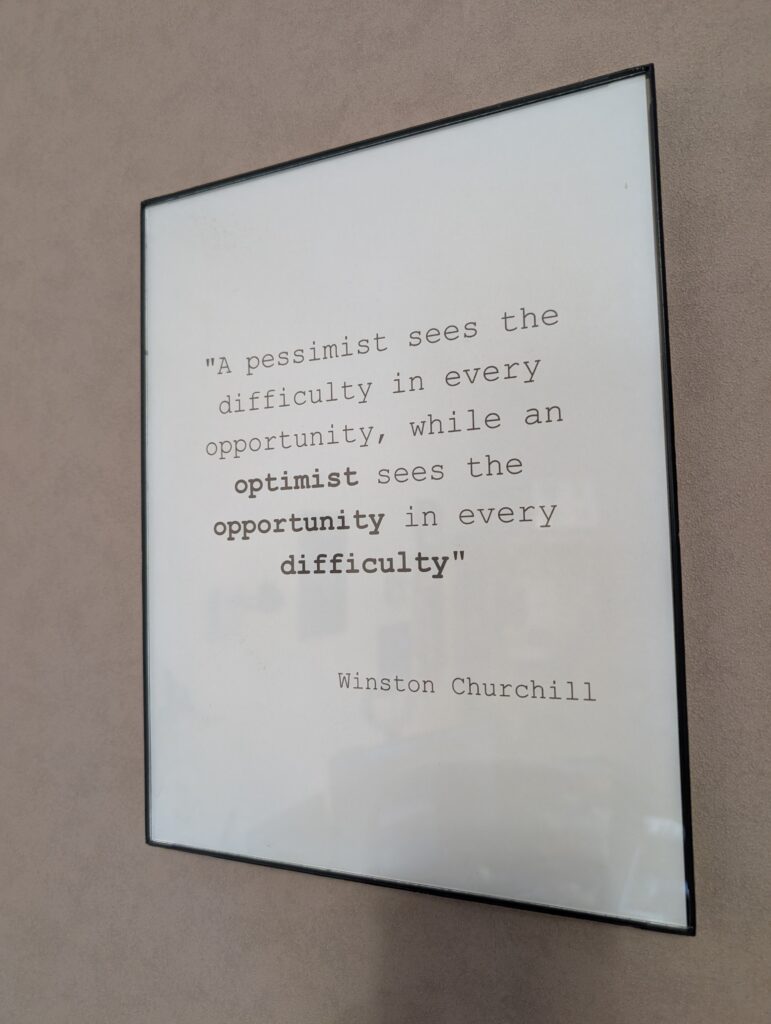
“A pessimist sees the difficulty in every opportunity, while an optimist sees the opportunity in every difficulty”
Winston Churchill

That one is actually hanging in my office right next to me, so I get reminded about it every day – it’s a little bit like seeing the glass half-full rather than half-empty:
Is AI going to destroy my current business offering? Most likely yes, so I need to embrace it and use that as an opportunity to pivot and offer something different. Change is an opportunity to learn and grow. This quote ties so nicely with the previous ones: Adapt to survive, make mistakes to learn, and then succeed. As Ryan Holiday puts it, the Obstacle is the way.

“Today I will do what others won’t, so tomorrow I can do what others can’t.”
Jerry Rice

Kevin Costner has a variation of that quote: “Being an entrepreneur is being willing to do a job that nobody else wants to do, in order to be able to live the rest of your life doing whatever you want to do“. The idea is the same. Nobody wants to feel the pain of failure, so most people won’t even try. Yet we must try, as this is how we pave our way to success.
How I built a cool art display with the help of AI

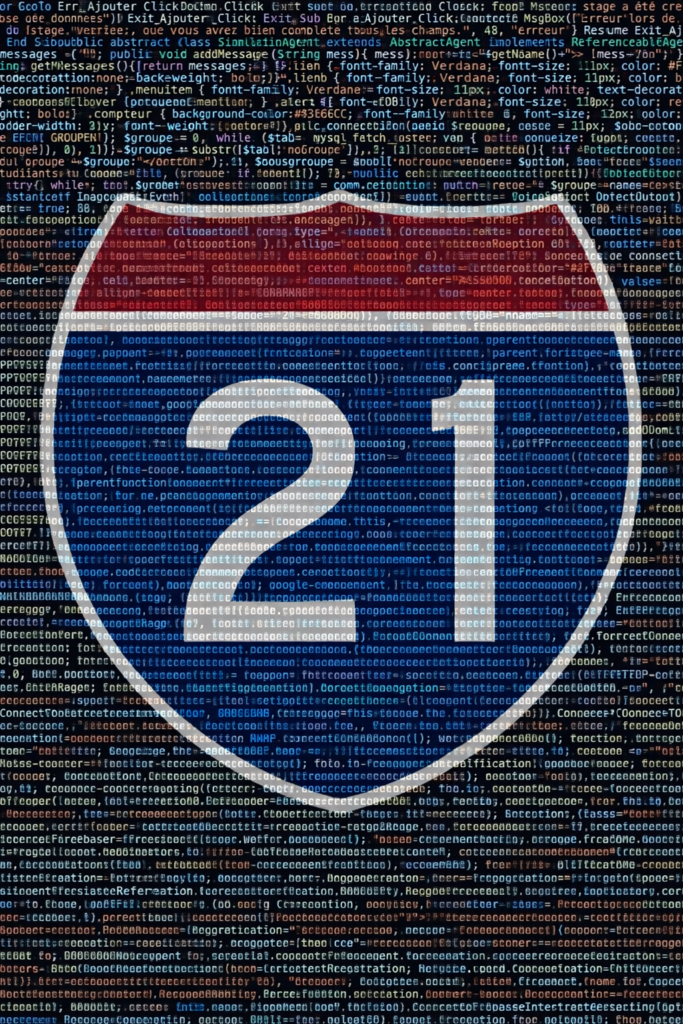
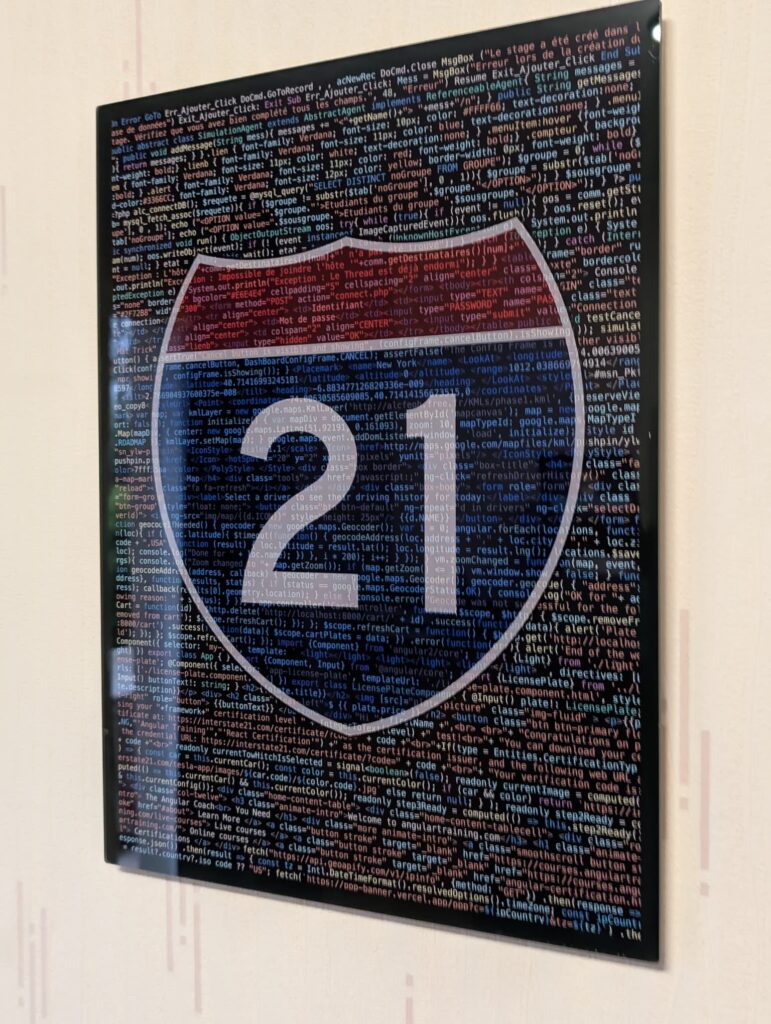
A few years ago, I came up with the idea of an art display to illustrate my tech history through code. The idea was to take meaningful code snippets from my career and have them “paint” a canvas on which the logo of my solo business, Interstate 21, would emerge. Basically, I wanted a “The Matrix”-like effect: a wall of code that draws the business’s logo, since that code ultimately created the business itself.

But I didn’t know how to make that happen without spending dozens of hours editing images and code samples.

In late 2025, I decided to prompt AI to do that for me. I got something interesting and fairly close to what I had in mind, but it would not use my code snippets, just random ones instead. Both Gemini and ChatGPT failed in a similar fashion despite multiple attempts:

The rendering was cool, but the code wasn’t mine, so I decided to do it manually. There were still a few hurdles:

  1. The goal was to illustrate my entire career, which means there would be different programming languages, all with different syntax coloring rules. But I wanted consistent colors on my canvas.
  2. Whitespace, tabs, and end of lines. Code editors want to format code properly and won’t cut the lines the way I wanted for this project.

Should I use a code IDE or image editor software? I wasn’t sure what the best approach would be for pixel-perfect rendering. This is where AI gave me a breakthrough. I prompted Gemini Pro with:

I want to create an image that shows different pieces of code in different programming languages, all with syntax coloring, with possibly one line for each example / language. Which process would you recommend for me to achieve this?

And the answer I would never have thought about on my own:

I recommend using Shiki (the syntax highlighter used by VS Code) over Prism.js because it uses TextMate grammars, ensuring the colors match your IDE exactly.

  1. Scaffold an HTML Page: Create a simple container with a dark background.
  2. Integrate Shiki: Use the CDN version to render code strings into HTML tokens on the fly.
  3. Layout with CSS: Use display: grid or flex to stack your one-liners vertically or artistically.
  4. Export: Use Chrome DevTools → Cmd+Shift+P → “Capture node screenshot” (generates a high-DPI PNG of just the container).

Then Gemini created a skeleton page I could use. That was the breakthrough I needed. With some more AI-assistance, I was able to describe my snippets using an array of JavaScript objects that looked like this:

{
        lang: 'java',
        description: 'Java code from university (simulation agent)',
        code: 'public abstract class SimulationAgent extends AbstractAgent implements ReferenceableAgent{ String messages = ""; public void addMessage(String mess){ messages += "<"+getName()+"> "+mess+"/n"; } public String getMessages(){ return messages; } }'
}

All I had to do was add more entries, refresh the HTML page, capture a screenshot, and be done.

Well, I actually spent hours going through my college archives, extracting code from PDF reports, GitHub repos, or old zip files from hard drives from 20 years ago… I failed to recover some Turbo Pascal samples that probably live on a floppy disk somewhere. Yes, I started coding before USB thumb drives and cloud storage solutions were a thing…

I considered using a decompiler to reverse-engineer compiled code in some instances, but my point was to render code I had written myself, so I gave up on that idea.

I found pieces of Visual Basic, SQL, Java, PHP, JavaScript, Google Maps API, KML, TypeScript, OutSystems syntax, HTML, CSS, Angular template syntax, AngularJS template syntax, and more…

There is code from my first internship in college, my first bug fix in a high-stakes university project, my first job, my first freelance Google Maps project, my first AngularJS training, the Angular certification program

It’s all there. My entire career, summarized in code snippets, is now hanging in my office, printed in a plexiglas frame:

Once I had the right process, it was really fun to get to the end result. What’s satisfying is that I don’t think I could have gotten to that result alone, and AI couldn’t either. I had to collaborate with AI to make the project happen, which is really the name of the game these days: Using AI for inspiration and help to reach new horizons.